Key takeaways
16 min read
Key point 1
There is no best chimney cap in the abstract: there is the one that matches what the flue extracts, its real size, the environment and the working temperature.
Key point 2
The first thing to know is what comes out of it: combustion fumes, stale air from bathrooms and kitchens, or both through separate ducts inside the same chimney box.
Key point 3
The static chimney cap works with no electrical consumption and solves most domestic outlets; the mechanical one is reserved for when the airflow to be extracted demands it.
Key point 4
The size is taken on the outside of the finished chimney box, not on the inner flue or on the approximate size in a catalogue.
Key point 5
Lacquered aluminum covers normal environments; AISI 316 stainless steel is recommended within 2,000 metres of the sea.
Key point 6
Every cap has a maximum working temperature, and that figure has to be checked against the appliance before buying.
Key point 7
An extract outlet must be protected against water and birds and kept well away from any ventilation intake.
In this article
- Why the Question 'Which Is Best' Is a Trick Question
- Criterion 1: What the Flue Extracts
- Criterion 2: Static or Mechanical
- Criterion 3: the Real Size, Not the Catalogue One
- Criterion 4: Material by Environment
- Criterion 5: Working Temperature
- Criterion 6: Geometry, Wind and Smoke Return
- What Standards Expect at the Extract Outlet
- How the Chimney Box Should Be Left Before the Cap Is Fitted
- Signs of a Chimney Cap That Isn't Worth It
- The Data Sheet for Requesting a Quotation
- VENTUM® by Industrias Mas
- Frequently asked questions
There is no best chimney cap in the abstract: there is the one that matches what the flue extracts, its real size, the environment and the working temperature.
The first thing to know is what comes out of it: combustion fumes, stale air from bathrooms and kitchens, or both through separate ducts inside the same chimney box.
The static chimney cap works with no electrical consumption and solves most domestic outlets; the mechanical one is reserved for when the airflow to be extracted demands it.
The size is taken on the outside of the finished chimney box, not on the inner flue or on the approximate size in a catalogue.
Lacquered aluminum covers normal environments; AISI 316 stainless steel is recommended within 2,000 metres of the sea.
Every cap has a maximum working temperature, and that figure has to be checked against the appliance before buying.
An extract outlet must be protected against water and birds, and kept well away from any ventilation intake.
Section 02
Why the Question 'Which Is Best' Is a Trick Question
If you search for the best chimney cap you'll find lists of products ranked by price or by reviews. The problem is that a chimney cap isn't a household appliance: it's a piece that crowns a specific outlet, of a specific size, on a specific building and for a specific use. The same model can be excellent on one roof and entirely unsuitable on the one next door.
Put another way: the useful question isn't which is best, but which is right for your outlet. And that is decided with six criteria you can work through in half an hour, with a tape measure and a little attention. This guide goes through them in the order in which it's best to tackle them, because each one conditions the next.
A warning up front that saves money: the chimney cap is the cheapest piece in the whole installation and sits at the most exposed point of the whole building. Choosing on price at that point turns out expensive, because a badly chosen cap doesn't fail in the first year, but in the third, when replacing it means going back up on the roof.
Section 03
Criterion 1: What the Flue Extracts
It's the first question and the one skipped most often. There are three very different situations that look very similar on the roof.
Combustion flue outlet. Wood chimney, stove, gas boiler, pellet or biomass installation. Hot gases come out here and, depending on the fuel, condensates with an acid load. The cap has to withstand that temperature and that chemical aggressiveness, and its geometry must help the draught rather than hinder it.
Stale air extraction. Bathroom and kitchen ventilation ducts, whole-home air renewal systems. There are no hot gases here, but there is an airflow that must be guaranteed continuously. It's the territory where a cap with mechanical extraction makes sense.
Ventilation of technical spaces. Lift shafts, service courtyards, garages, concealing rooftop air-conditioning plant. They usually need large passage areas and often dimensions outside any catalogue.
The reason this criterion comes first is that it conditions everything else: the material, the permissible temperature, whether or not a motor is needed and even how the measurements are taken. And there is a very common mixed case in multi-dwelling buildings: a single chimney box grouping several independent ducts — cooker hood, bathroom, boiler — and crowned with a single piece. There the decision isn't made per duct, but for the whole.
Section 04
Criterion 2: Static or Mechanical
It's the main fork in the market and the one that causes the most confusion.
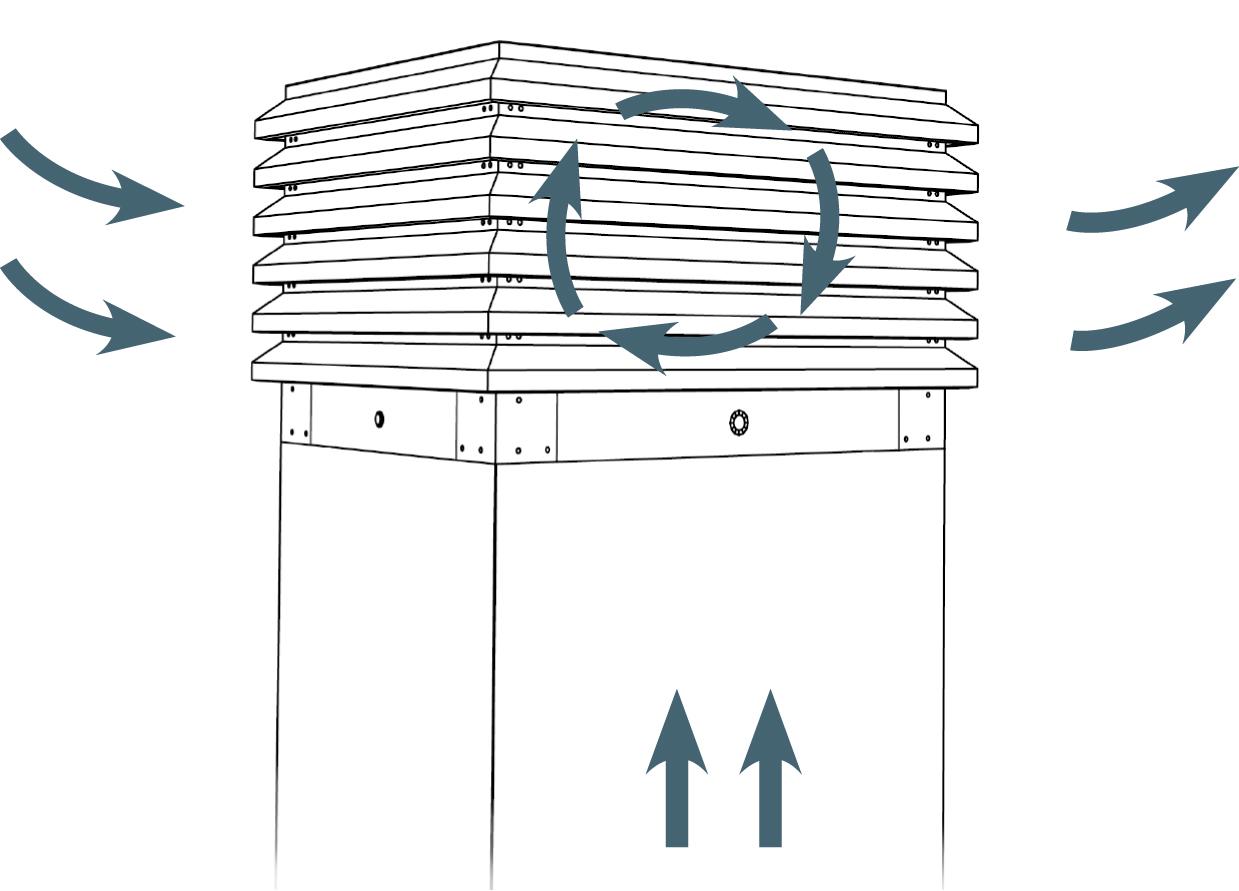
The static chimney cap has no motor and no electrical consumption. The shape of the piece does the work: as outside air passes between the louvers, a low pressure is created above the mouth of the flue that helps the air or the smoke out, instead of pushing it back in. It's the right solution for cooker hoods, gas boilers and open-fire chimneys, and it solves the great majority of domestic outlets with no electrical maintenance.
The mechanical chimney cap incorporates an extractor motor inside. It's justified when a given airflow has to be guaranteed continuously — ventilation of wet areas, bathrooms and kitchens in multi-dwelling buildings — or when natural extraction doesn't deliver what the installation needs.
The selection criterion isn't 'mechanical is better'. It's: is there an airflow that has to be guaranteed by the project or by regulation? If so, mechanical. If not, and the flue behaves reasonably, static, which doesn't consume, doesn't break down and doesn't make noise.
If the answer is mechanical, the choice of model depends on the airflow to be extracted, and two references are worth having to hand. The first is that a Ø100 mm duct at a velocity of 4 m/s moves in the order of 70 m³/h, so the total airflow can be estimated by counting the pipes feeding into the box. The second is that each motor model requires a minimum internal chimney box size, and that has to be checked before buying, not after:
- Model 4-200, up to about 77 l/s, with 35 W maximum absorbed power: minimum internal box 300 × 300 mm.
- Model 4-250, up to about 170 l/s, with 52 W: minimum internal box 445 × 445 mm.
- Model 6-315, up to about 300 l/s, with 69 W: minimum internal box 540 × 540 mm.
- Model 6-355, up to about 454 l/s, with 87 W: minimum internal box 610 × 610 mm.
There is also a supply-fan variant, for cases where what's needed is to bring air in rather than extract it, with lower-flow models.
An installation detail that's often forgotten: a mechanical extractor of this type should be fitted with an electronic voltage regulator, which lets you adjust the motor's power to the real airflow the installation needs. Without it, the motor always runs at maximum, with the noise and consumption that implies.
Section 05
Criterion 3: the Real Size, Not the Catalogue One
This is where the highest percentage of failed purchases is concentrated.
The measurement that defines the cap is the outside of the finished chimney box: the length and width of the box from face to face, in millimetres, taken on the final finish. It isn't the measurement of the inner flue, or of the opening, or of the brick before rendering.
Three checks that avoid the mistake:
Measure both directions and all four faces. Chimney boxes are rarely perfect squares. If two opposite faces don't match, always note the larger and flag the difference: the box is irregular and has to be made accordingly.
Measure on the final finish. If the box is going to be rendered, plastered or clad and isn't yet, the right measurement is the design one with the finish in place. It's the classic mistake in new build.
Check the plumb and the state of the top. A box out of plumb or with a deteriorated top won't allow correct seating however well the piece is made.
And here comes the underlying argument of this guide. A standard-size cap applied to a box that doesn't match forces one of two things: either it sits loose, and then water gets in and the wind can dislodge it, or it has to be trimmed and forced on site, and then the continuity of the cap is lost. Both end the same way: damp in the box, stains on the top and, at worst, the piece on the ground after a storm.
That's why made-to-measure manufacture isn't a premium extra on this product: it's the normal way to do it properly. The piece is made to the exact size of the box and with the manufacturing allowance needed to seat without gaps, instead of being adjusted with a hammer.
Section 06
Criterion 4: Material by Environment
There are two real options and a fairly clear criterion for deciding between them.
Lacquered aluminum. It's the standard and covers the vast majority of installations. It's light — which matters on a piece that crowns a box with no fixing other than its anchors — resists atmospheric corrosion well, needs no maintenance and is lacquered in any RAL colour to blend with the roof.
AISI 316 stainless steel. It's reserved for more demanding conditions: environments with chlorides, aggressive industrial atmospheres and fuels that generate more acidic condensates, such as pellet and biomass.
The most useful practical criterion that can be given is distance to the sea: within 2,000 metres of the coast, the recommendation is stainless steel. It's a specific threshold, easy to check on a map, and it avoids the abstract argument about which material is 'better'. Beyond that distance, and in a normal urban or rural setting, lacquered aluminum is the logical choice and there's no reason to pay more.
There is a third variable that shouldn't be forgotten: the visible finish. The cap is seen from the street and from the homes opposite. On roofs with several chimney boxes, unifying the colour does more for the final result than any other aesthetic decision on the roof.
Section 07
Criterion 5: Working Temperature
This is the criterion almost no buyer looks at and the one that causes the most problems when overlooked.
Every metal cap has a maximum working temperature in continuous operation. Above it, the lacquer degrades, the joints suffer and the service life of the piece shortens noticeably. It's a figure that should appear on the data sheet and that has to be checked against two things: the appliance that is venting and the configuration of the flue.
The configuration matters as much as the appliance. A cap crowning a chimney box with an independent pipe running all the way to the top — where the cap works at a much lower temperature than the gases — isn't the same as a cap fitted directly onto the mouth of the flue. In the first case the piece is protected; in the second it takes the gas full on.
That's why the buying recommendation is specific: if the outlet is for solid fuel — wood, pellet, biomass — don't buy from a catalogue. Check the flue configuration with the manufacturer before ordering, stating the appliance, the type of flue and whether or not the pipe reaches the top of the box. It's a two-minute enquiry that avoids replacing the piece in three years.
For stale air extraction and for gas boilers the matter is much less critical, because working temperatures are considerably lower.
Section 08
Criterion 6: Geometry, Wind and Smoke Return
The difference between a cap that helps and one that hinders lies in its shape, and shows above all on windy days.
The draught of a flue occurs because the hot air inside is less dense than the outside and tends to rise. To that mechanism is added — or subtracted — the effect of the wind on the mouth. When the wind hits a well-resolved piece, the air accelerates as it passes through and creates a low pressure right above the outlet, which pulls the smoke out. When it hits an unprotected mouth or a badly conceived lid, it can do the opposite: press on the outlet and cause backflow.
Two things to look at on the product data sheet follow from that.
The first is whether the design is anti-downdraught, that is, whether the piece is designed to create low pressure over the flue and not just to keep off the rain. Most of the cheap chimney caps on the market only do the latter.
The second, on made-to-measure pieces, is whether the height of the cap and the spacing between louvers stay constant when the outside dimensions change. If the proportions are stretched when a larger piece is made, the capacity to create low pressure changes and the behaviour is no longer the same. Keeping those two dimensions unchanged is what lets a made-to-measure piece behave the same as one of standard size.
It's also worth looking at the construction: a piece whose parts are joined with expanding embossed fixing points, with no welds, keeps the properties of the material at the joints, which is where a welded cap outdoors starts to fail first.
Section 09
What Standards Expect at the Extract Outlet
For ventilation ducts, the reference in England is Approved Document F. An extract outlet is the outer end of the extraction duct through which the stale air leaves, and it must be protected so that water and birds can't enter. In other words: the cap isn't an optional accessory, it forms part of the required solution.
As regards its position on the roof, three checks are worth making before buying anything:
- Keep extract outlets well separated from any ventilation intake — air intakes, supply openings, external doors and windows. It's the condition most often broken by an improvised outlet in a refurbishment. The exact separation is set by the standard and by the system manufacturer's guidance for your project.
- Fit bird mesh or similar protection.
- For passive stack or hybrid ventilation, the outlet must clear the roof by a suitable height, and clear any nearby obstacle. Follow the system manufacturer's requirements for the height above the roof and above nearby obstacles.
Each extract duct should also finish at its outlet with a static, hybrid or mechanical extractor suited to the ventilation system, and ducts should be vertical, of uniform section and accessible for cleaning.
For flue gas discharge ducts the framework is different: the reference is the building regulations for combustion appliances (in England, Approved Document J) and the standards for the design of chimneys, as well as whatever the local authority sets, which in many areas adds its own conditions on height and separation.
Section 10
How the Chimney Box Should Be Left Before the Cap Is Fitted
A good cap on a badly finished box still causes problems. These are the conditions worth resolving before the piece goes up.
Individual ducts. Each bathroom and each kitchen should have its own duct all the way to the roof. Sharing them is the usual cause of noise, odour and cross-ventilation problems between dwellings.
Pipes below the top. The recommendation is to leave them about 20 cm below the upper level of the chimney box and seal them to each other with polyurethane foam. That way the cap extracts only the air from inside the pipes, and not the air in the box itself, which is what happens if they are left open and what ruins extraction performance.
Solid top. It's worth concreting the last three courses of brick solidly, preferably with reinforcement, so a strong gust doesn't tear off the top with the cap on it. It's a cheap precaution that pays off on exposed roofs.
Clean, level top. The cap must seat on a regular surface. A well-resolved base also acts as a drip and prevents moisture getting in at the seating.
Section 11
Signs of a Chimney Cap That Isn't Worth It
Without needing to be an installer, there are fairly reliable indications.
It's only sold in fixed sizes. If the offer is limited to three or four sizes, the fit to your real box will depend on luck.
The data sheet doesn't state the maximum temperature. If that figure doesn't appear, there is no way of knowing whether the piece suits your appliance.
Behaviour in wind isn't mentioned. A piece described only as a 'rain lid' is probably just that.
The material is described as 'metal' or 'steel'. It matters a great deal whether it's lacquered aluminum, AISI 316 stainless or plain galvanised steel, especially near the sea.
No fixing accessories included. Fixing to the box is part of the solution, not an add-on.
No downloadable drawings or technical documentation. If nobody can incorporate the piece into a construction detail, it isn't designed to be installed properly.
Section 12
The Data Sheet for Requesting a Quotation
With this information, a quotation is closed without back-and-forth:
- Outside length and width of the finished chimney box, in millimetres, indicating whether the box is irregular.
- Number of units.
- Type: static or mechanical. If mechanical, the airflow to be extracted or the number and diameter of the pipes feeding in.
- What the flue extracts: combustion fumes, stale air or both, and with which appliance.
- Approximate distance to the sea, to decide the material.
- Finish: RAL colour or stainless steel.
- Special needs: different height, blind face to sit against a wall, non-rectangular shape, joining of two pieces.
- Dimensioned sketch or photograph of the box, if there is any particularity.
The quotation form accepts attached documentation in PDF, JPG, PNG, XLSX, CSV, DWG and DXF up to 10 MB, so you can send the drawing or the photo of the roof directly.
Section 13
VENTUM® by Industrias Mas
VENTUM® is the Industrias Mas range of chimney and ventilation caps, with more than 200,000 units manufactured. It's made to measure, in a static version and in a mechanical version with integrated motor, in lacquered aluminum or in bright AISI 316 stainless steel, with an anti-downdraught design and a base prepared for direct anchoring onto the chimney box, with no additional masonry work.
The range is completed with off-catalogue solutions for one-off projects: non-rectangular shapes, special heights, blind faces when the box sits against a wall, joining pieces for large dimensions and caps for masonry chimneys and concrete ducts. The height of the piece and the spacing between louvers stay constant regardless of the outside dimensions, so the capacity to create low pressure doesn't change when large pieces are made.
Industrias Mas Salvadó y Sucesores has manufactured aluminum construction products since 1968, with its own plant in Tàrrega (Lleida) and an ISO 9001:2015 certified quality system.
To incorporate the piece into the project, the following are available: the technical catalogue, the dimensional drawing, the 2D drawing, the static ventilation system diagram and the extraction operation diagram.
FAQ
Frequently asked questions
What is the best chimney cap?+
The one that matches your outlet. It depends on what the flue extracts, the real size of the chimney box, the environment — above all distance to the sea — the working temperature of the appliance and whether a specific airflow has to be guaranteed. A cap that's excellent on one installation can be unsuitable on another two hundred metres away.
Static or mechanical?+
Static if there is no airflow to guarantee by project or by regulation: it works with no electrical consumption and solves most domestic outlets. Mechanical when extraction has to be ensured continuously, typically for bathroom and kitchen ventilation in multi-dwelling buildings.
What measurements do I need to take?+
The outside length and width of the finished chimney box, in millimetres. Not the measurement of the inner flue or of the unrendered brick. If two opposite faces don't match, the larger is noted and it's stated that the box is irregular.
Lacquered aluminum or stainless steel?+
Lacquered aluminum for normal environments: it's light, resistant to atmospheric corrosion and needs no maintenance. AISI 316 stainless steel within 2,000 metres of the sea, in aggressive atmospheres and on pellet or biomass installations, whose condensates are more acidic.
Will any chimney cap do for a wood stove?+
No. You have to check the cap's maximum working temperature and how the flue is arranged: whether the pipe reaches the top of the box or the cap is fitted directly onto the flue outlet. With solid fuel it's worth checking the configuration with the manufacturer before buying.
What box size do I need if I want mechanical extraction?+
It depends on the motor, and the motor depends on the airflow. As a reference, the usual models require minimum internal box sizes of 300 × 300, 445 × 445, 540 × 540 and 610 × 610 mm in ascending order of airflow. It's worth checking before deciding, because it conditions the building work.
How do I calculate the airflow I need to extract?+
A quick estimate: a Ø100 mm duct at 4 m/s moves in the order of 70 m³/h, so the total airflow is approximated by counting the pipes feeding into the box. For final sizing you have to work to the minimum extract rates for each room, such as those in Approved Document F.
What do the regulations say about where the outlet can go?+
For ventilation ducts, the extract outlet must be protected against water and birds and kept well separated from any ventilation intake, external door or window. For passive or hybrid systems there are also minimum heights above the roof and clearance from nearby obstacles. Check Approved Document F and the system manufacturer's guidance for the exact values on your project.
Is it worth ordering made to measure?+
On this product, yes. A standard cap on a box that doesn't match sits loose — with water ingress and a risk of being displaced by wind — or has to be trimmed on site. Made-to-measure manufacture doesn't add significant cost and removes the two most frequent causes of failure.
Does it need maintenance?+
A static cap in lacquered aluminum or stainless steel needs no periodic maintenance beyond a visual inspection when the roof is checked. On mechanical ones you have to allow for the motor, which does have a service life and should be accessible.
Related product
VENTUM®
Made-to-Measure Chimney Caps and Cowls
Made-to-measure chimney cap, static and mechanical
Share