Key takeaways
8 min read
Key point 1
An open flue 20 cm in diameter collects more than 3 liters an hour in rain of 100 mm/h.
Key point 2
Rainwater dissolves combustion deposits and becomes markedly more aggressive than the water it started as.
Key point 3
Rain and condensation are told apart by when they appear and what the liquid looks like. The solutions are different.
Key point 4
A flat lid doesn't work: it throttles the flow, creates positive pressure over the opening and doesn't protect against wind-driven rain.
Key point 5
The solution isn't to cover the opening, but to protect it while maintaining or improving the airflow.
In this article
- Where That Water Goes
- Damage That Speeds Itself Up
- Rain or Condensation: How to Tell Them Apart
- Why a Flat Lid Isn't the Answer
- What a Well-Designed Cap Does
- The Flue Matters Too
- Industrias Mas VENTUM® Caps: Specifications
- How to Order a Rain Cap Without Mistakes
- Common Mistakes on Site
- Frequently asked questions
A chimney flue with no cap is a funnel pointing at the sky. The description is literal, and the numbers back it up.
A 20-centimeter flue has an opening of about 314 cm². Under rain of 100 mm per hour — an intensity regularly reached during summer thunderstorms across much of Europe — that opening collects more than 3 liters of water an hour.
Three liters falling straight into the installation. And they don't leave the way they came in.
Section 02
Where That Water Goes
The route depends on the installation, but the destination is always one of these four.
Into the appliance. In the most direct case, water reaches the stove or boiler. On appliances with electronics — and practically every pellet stove has them — this can be terminal.
Onto the flue walls. The water mixes with soot and accumulated deposits. In a wood-burning installation it forms a paste that sticks to the walls; in a pellet installation it adds to the acidic condensate and multiplies its corrosive power.
Into the masonry chimney stack. If the flue runs inside a brick stack, the water saturates the masonry from the inside. Efflorescence appears on the outer faces, the joint mortar deteriorates and, where there are frosts, the freeze cycle spalls the brickwork course by course.
Into the home. The case that's detected latest and costs the most. The stain appears on the top-floor ceiling or on the wall the flue runs through, weeks after the process started, and usually gets blamed on a roof leak.
Section 03
Damage That Speeds Itself Up
There's a detail worth understanding, because it explains why the problem gets worse faster than expected.
Rainwater is slightly acidic because of dissolved atmospheric CO₂. Once inside a flue, it also dissolves the sulfur and chlorine compounds in the combustion deposits. The resulting liquid is noticeably more aggressive than the water it started as.
That liquid attacks the flue material, exposes fresh surface, and that fresh surface corrodes in turn. The process isn't linear: it feeds itself.
In pellet installations the effect adds to that of the combustion condensate, which is already acidic on its own. That's why AISI 316 stainless steel is recommended for pellets: its molybdenum content gives it resistance to acids and chlorides.
Section 04
Rain or Condensation: How to Tell Them Apart
Before doing anything, identify the source, because the solutions are different and the two are often confused.
It's rain if the water appears in step with rainfall, a few hours behind; if the liquid at the base of the flue is relatively clear, even if it carries some soot; if it also happens with the appliance off, even out of season; and if the volume is noticeable after a storm.
It's condensation if it appears while the appliance is running or in the hours after it's switched off; if it's persistent, small in volume but continuous; if the liquid is dark, thick and tar-like in wood-burning installations; and if it gets worse with low outside temperatures and long uninsulated external runs.
If it's rain, the solution is the cap. If it's condensation, the solution lies in insulating the flue, sizing the cross-section correctly and, where needed, a condensate collection system. A cap won't fix a condensation problem.
It's perfectly possible for both to happen at once, and in fact that's normal in older installations with no cap.
Section 05
Why a Flat Lid Isn't the Answer
The instinctive reaction to a flue that collects water is to cover it. A sheet resting on the opening, or a flat lid held up on rods.
It's a poor solution, for three reasons.
It throttles the flow. If the gap between the lid and the opening is small, the resulting free area falls below the internal cross-section of the flue. The draft drops, especially on cold starts, which is when it's weakest.
It creates positive pressure over the opening. A flat surface facing the wind creates a zone of positive pressure right above the outlet. The result is downdraft: smoke coming back inside with certain wind directions.
It doesn't protect against wind-driven rain. Rain doesn't fall vertically. With wind, a flat lid with no side skirt lets water in from the sides almost as easily as having no lid at all.
The right solution isn't to cover the opening, but to protect it while maintaining or improving the airflow.
Section 06
What a Well-Designed Cap Does
Three things at once.
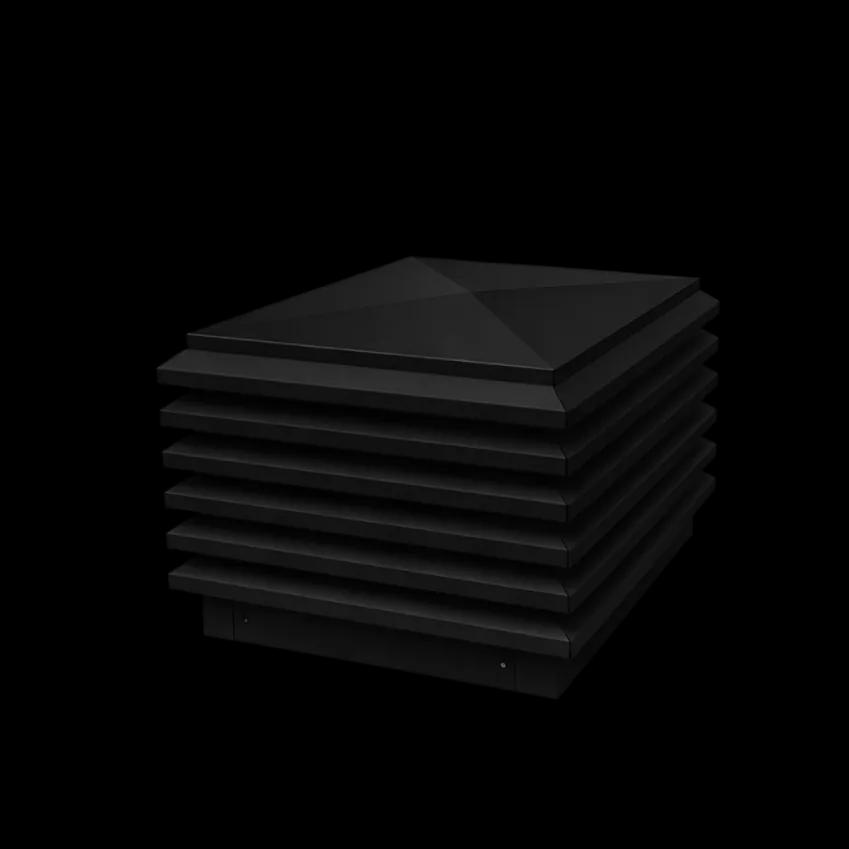
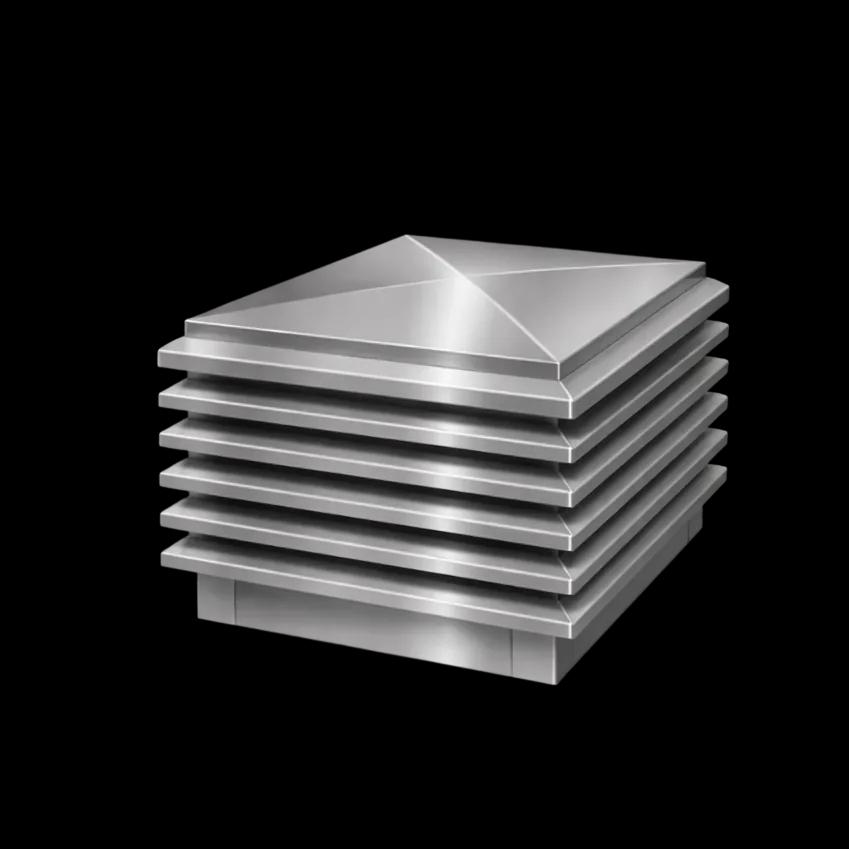
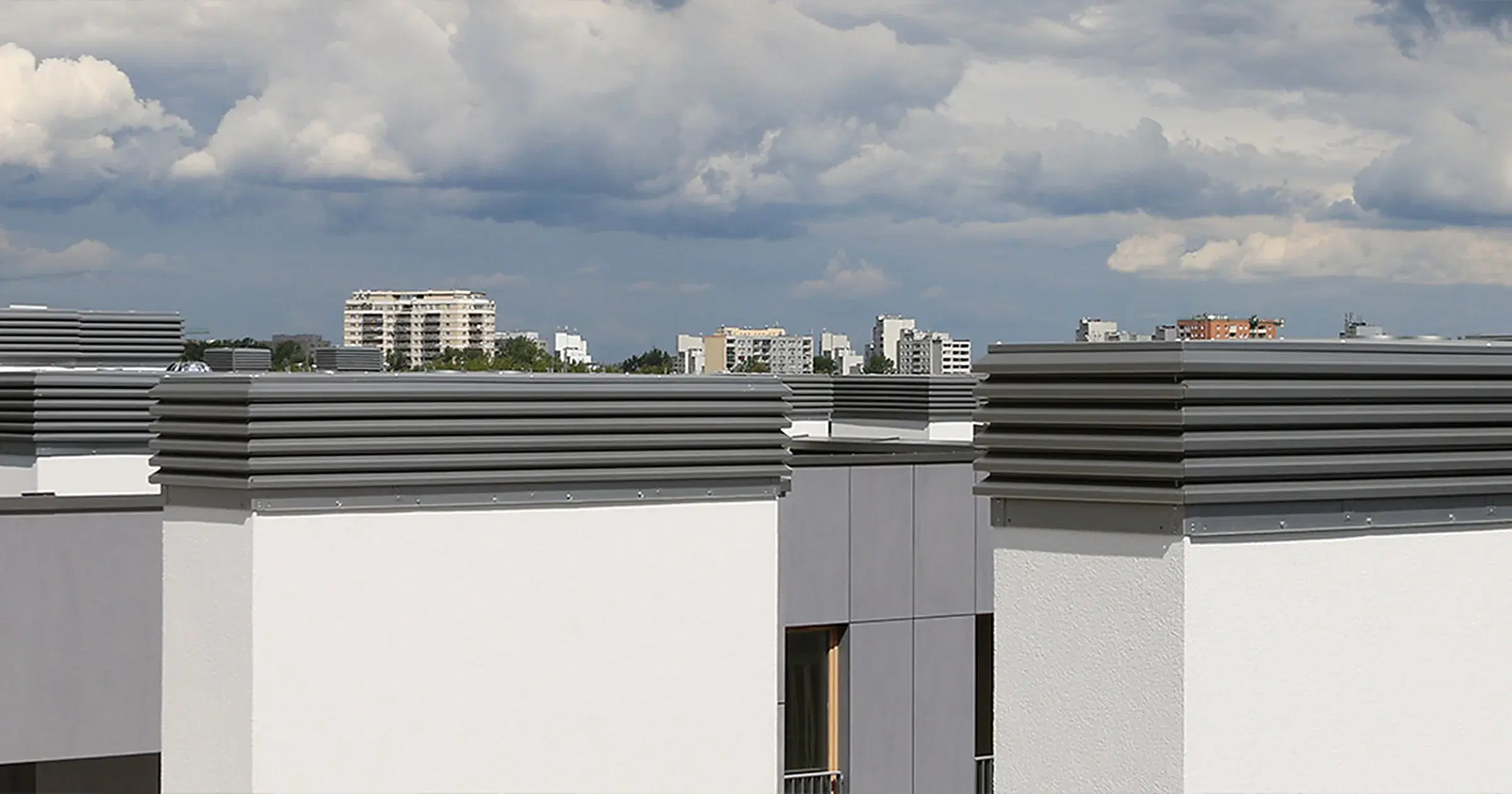
It intercepts the water without closing off the flow. A set of horizontal louvers around the whole perimeter blocks the direct path of the raindrop — including rain driven in at an angle by the wind — while letting air flow freely through the effective cross-section.
It uses the wind instead of suffering it. Passing through the louvers, the air is forced through a narrower section and speeds up. That increase in speed comes with a drop in pressure — the Venturi principle — and that suction, applied over the opening, helps extraction.
It keeps water off the masonry stack. The base of the cap acts as a drip edge, so water running down the outside of the piece falls clear of the wall instead of running down the faces of the stack. That's what prevents dark streaks and saturated masonry.
Section 07
The Flue Matters Too
The cap deals with water entering through the opening. There are two more points where water can get in, and they're worth checking in the same visit.
Where it meets the roof. If the flue passes through the roof slope, that penetration should be detailed with properly lapped flashing — under the roof covering on the upper side, over it on the lower side — not with sealant.
The top of the masonry stack. The top face of the stack is horizontal and absorbs water like any wall top. A stack with no capping on top saturates the masonry from above, however well the flue opening is protected.
Section 08
Industrias Mas VENTUM® Caps: Specifications
VENTUM® caps are made to measure for chimneys and ventilation ducts, to the real dimensions of the opening or the masonry stack.
- Material: 1.2 mm lacquered aluminum. Also available in 0.8 mm bright AISI 316 stainless steel.
- Lacquer: 25 microns of polyester lacquer, resistant to corrosion, UV and temperature swings.
- Standard dimensions: 500 mm overall height, 405 mm effective height and a 95 mm base skirt.
- Louvers: 6 horizontal louvers that intercept rain around the whole perimeter and create suction over the opening through the Venturi effect.
- Assembly: joined by expanding clinch points, with no welds.
- Base: designed for quick fixing; also acts as a drip edge, keeping water off the faces of the masonry stack.
- Installation: no masonry work required.
- Options: removable side for inspection and maintenance.
- Standard colors: RAL 9005, 7016, 9006, 7022 and 9003. Any other RAL to order.
- Certification: ISO 9001:2015.
Section 09
How to Order a Rain Cap Without Mistakes
- Real dimensions of the flue opening or the top of the masonry stack.
- Internal cross-section of the flue, to check that the cap's free area matches or exceeds it.
- Type of installation: wood, pellets, gas or ventilation.
- Location and distance from the sea, which determine the material recommendation.
- Material and RAL reference.
- Condition of the top of the stack, in case it also needs its own capping.
Section 10
Common Mistakes on Site
- Covering the opening with a flat sheet, which throttles the flow and causes downdraft.
- Choosing the cap by nominal diameter without checking the effective free area.
- Blaming rain for a condensation problem, or the other way round, and fitting the wrong solution.
- Fixing the opening and leaving the top of the stack uncapped, so it keeps absorbing water.
- Sealing the junction with the roof instead of detailing it with properly lapped flashing.
- Fitting lacquered aluminum on a pellet flue, exposed to acidic condensate.
FAQ
Frequently asked questions
How much water can really get into an open flue?+
It depends on the diameter and the rainfall intensity. Since 100 mm/h equals 0.1 meters of water per hour, just multiply by the area of the opening: a 20 cm flue collects just over 3 liters an hour; a 30 cm one, around 7.
Does a cap reduce the draft?+
A badly sized one, yes. One designed to create suction over the opening helps the draft. The check is always the same: the cap's effective free area against the internal cross-section of the flue.
I have a cap and water still gets in. What should I check?+
Three things, in this order: whether the cap really covers the opening in every direction or its skirt is too short for wind-driven rain; whether the problem is actually condensation; and whether the water is coming in where the flue meets the roof rather than through the opening.
Does it work for ventilation ducts as well as flues?+
Yes. An open ventilation duct collects exactly the same water, with the added problem that it usually leads straight into the home. The material can be lacquered aluminum, since there's no aggressive condensate.
Can it be fitted on an old chimney?+
That's the most common case. We take the real measurements of the opening or the masonry stack and make the piece to those dimensions. It needs no masonry work and the existing capping doesn't have to be rebuilt.
Which material should I choose?+
Lacquered aluminum for ventilation and for installations without aggressive condensate. AISI 316 for solid fuel, especially pellets. And bright AISI 316 whenever the site is less than 2,000 meters from the sea.
Are they made to measure?+
Yes, to the real dimensions of the opening or the stack, including rectangular or special shapes.
Water at the base of your chimney and no idea where it's coming from?+
Tell us when it appears and what the liquid looks like, and we'll help you work out whether it's rain or condensation before deciding on the solution.
Related product
VENTUM®
Made-to-Measure Chimney Caps and Cowls
Made-to-measure chimney cap, static and mechanical
Share