Key takeaways
11 min read
Key point 1
Poor draft usually comes down to height, cross-section, gas temperature, lack of make-up air or the surroundings.
Key point 2
Backdraft (smoke coming back) appears with wind and crossed pressures over the flue outlet.
Key point 3
The cap solves problems of the outlet and of wind; it doesn't correct a badly executed height or cross-section.
Key point 4
The VENTUM® C Series works on the Venturi principle: the louver geometry generates internal suction with no motor.
Key point 5
When natural extraction isn't enough, the E Series incorporates a motor sized by airflow.
Key point 6
Manufactured to the exact size of the masonry surround: no adjustments or adaptors on the roof.
In this article
- How a Chimney's Draft Works
- The Six Most Common Causes of Poor Draft
- What Backdraft Is and Why Smoke Returns in the Wind
- How to Tell Poor Draft From Backdraft
- Diagnosis: How to Work Out What's Failing in Your Case
- How the Right Cap Helps
- VENTUM® C Series: Static Ventilation by Suction
- VENTUM® E Series: Mechanical Extraction When Natural Draft Isn't Enough
- Materials and Finishes: When Stainless Steel Is Needed
- The Masonry Surround: The Mistakes That Doom the Draft Before Anything Is Installed
- What to Measure Before Ordering the Cap
- Frequently asked questions
A chimney that won't draw properly, or smoke that comes back into the room when the wind picks up, is fixable — but rarely with a single measure. Draft depends on the temperature of the gases, on the height and cross-section of the flue, on the air entering the room, and on what happens right at the outlet. Changing the cap without understanding what's failing is the fastest way to spend money without solving anything.
In this guide we go through the causes of poor draft and backdraft, how to diagnose them one by one, and in which specific cases the cap is the real solution, with the technical specifications of the VENTUM® chimney caps we manufacture.
Section 02
How a Chimney's Draft Works
Draft is the pressure difference that pushes hot gases up the flue. It's generated by two mechanisms acting at once:
- Thermal draft: hot gases are less dense than outside air, so they rise. The greater the temperature difference and the greater the height of the flue, the stronger the effect.
- Wind effect at the outlet: air passing over the outlet can generate suction, which helps, or overpressure, which hinders. This is where the geometry of the cap changes everything.
And there's a third, indispensable condition: for air to leave through the chimney, air has to enter somewhere. A very airtight home with no make-up air throttles the draft no matter how well the flue is built.
Section 03
The Six Most Common Causes of Poor Draft
- Insufficient height
The outlet sits below the ridge or below nearby obstacles and falls into the turbulence zone of the roof itself. It's the most common cause and the one no cap corrects on its own: if the flue is short, it has to be extended.
- Inadequate cross-section
A flue that's too narrow can't evacuate the volume the appliance generates. One that's too wide is a less intuitive problem but just as real: the gases cool as they rise, lose buoyancy and the draft becomes unstable, particularly when lighting.
- Gases that are too cold
An uninsulated flue, or one running up an external facade, cools the flue gases and kills the thermal draft. It's typical of the first hour after lighting and of chimneys that only run in winter after weeks standing idle.
- Lack of make-up air
Airtight windows, kitchen extractors and mechanical ventilation systems compete with the chimney for the same air. If the room doesn't replace what goes up the flue, the draft drops. A very simple test: open a window and see whether behavior improves immediately.
- Obstructions and dirt
A build-up of soot, nests, construction debris or a badly closed access door reduces the effective cross-section. It's worth ruling this out before any other hypothesis, because it's the cheapest thing to check and to fix.
- The environment around the outlet
Trees, party walls, roof slopes, taller buildings or even a neighbouring chimney create zones of turbulence and overpressure over the outlet. This is the cause where the cap genuinely is the correct technical solution.
Section 04
What Backdraft Is and Why Smoke Returns in the Wind
Backdraft is the momentary reversal of the draft: instead of leaving, the smoke comes back into the room. It isn't a continuous fault but an episode, and that intermittency is its characteristic signature.
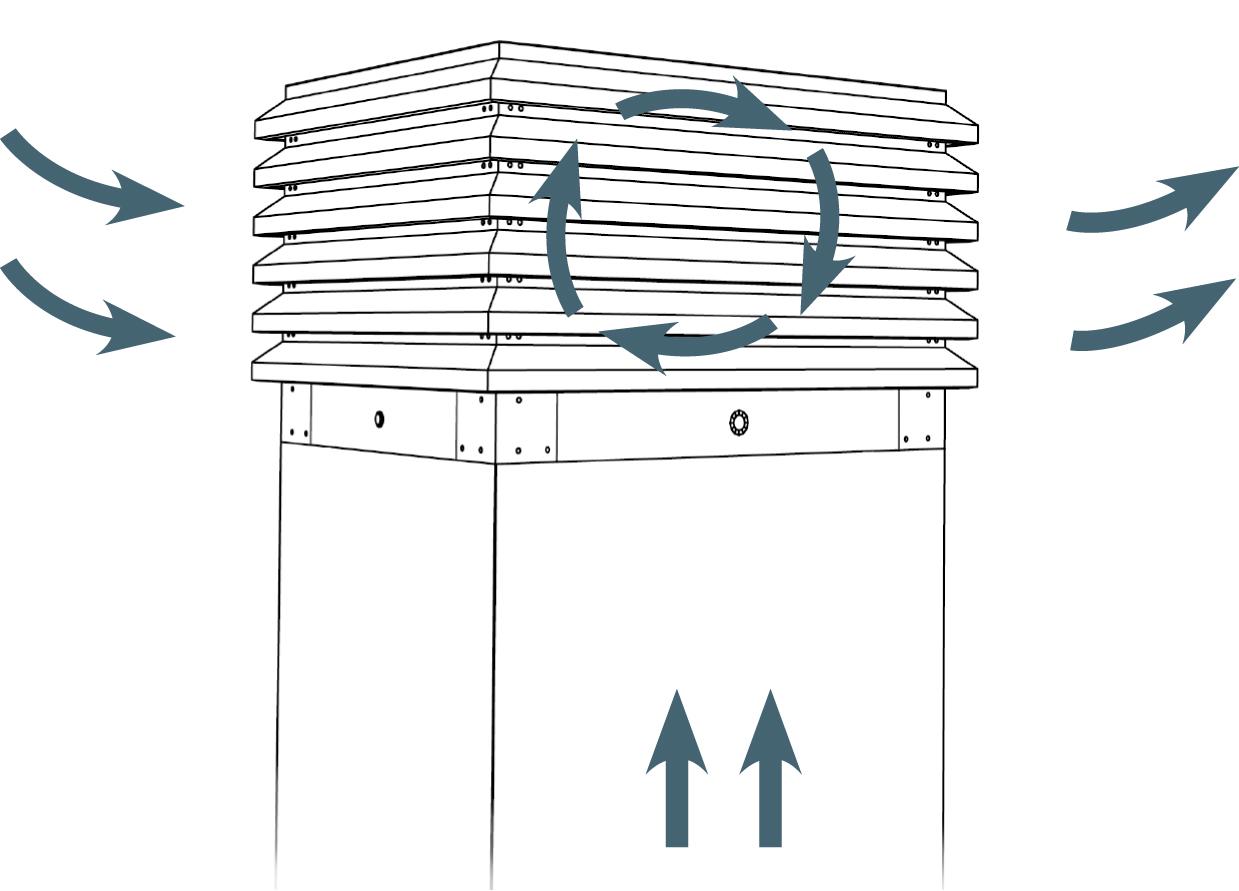
The mechanism is this: when wind hits an obstacle close to the flue outlet — a roof slope, a party wall, a building — zones of overpressure are created. If the outlet sits within one of those zones, the external pressure momentarily exceeds that of the flue and pushes the gases back inside. That's why the problem appears with certain wind directions and disappears with others.
A poorly conceived cap can make it worse: if its geometry lets the wind enter the flue instead of passing over it and generating suction, it's aggravating exactly what it was supposed to correct.
Section 05
How to Tell Poor Draft From Backdraft
- Poor draft: constant. Hard to light, a sluggish flame, smoke leaving slowly whatever the weather.
- Backdraft: episodic. The chimney works fine most days and fails on windy days or with one particular orientation.
The diagnosis changes the solution completely: the first points to the flue, the second to the outlet.
Section 06
Diagnosis: How to Work Out What's Failing in Your Case
Before buying anything, this order of checks rules out the cheap things first and avoids intervening on the wrong cause:
Is the flue clean? Sweeping and inspection of access doors. This comes first, always.
Does it improve when you open a window? If so, the problem is make-up air, not the flue or the cap.
Does it only fail in wind? Note the days and the wind direction. If the pattern is clear, it's backdraft and the cap is the way forward.
Does it always fail, especially when lighting? That points to cold gases or an oversized cross-section. Check the flue insulation.
Where does the outlet sit relative to the ridge and to nearby obstacles? Measure it. If it's below, it needs extending.
Does the flue serve other appliances? Shared flues create interference between dwellings: noise, odours and unstable draft.
Section 07
How the Right Cap Helps
The cap acts at exactly the point where the flue meets the wind. A well-designed cap does three things at once:
- It converts wind into suction instead of letting it penetrate the flue, stabilising the draft precisely in the conditions that previously reversed it.
- It protects the outlet from rain, snow, leaves and birds, which are causes of progressive obstruction.
- It finishes the masonry surround with a completed edge and, in the case of VENTUM®, with a base that acts as a drip edge and prevents moisture getting in.
That said, it's worth being honest about its limits: the cap solves problems of the outlet and of wind. It doesn't correct insufficient height, a badly sized cross-section or a home with no make-up air. If the diagnosis points to those causes, the installation has to be addressed too.
Section 08
VENTUM® C Series: Static Ventilation by Suction
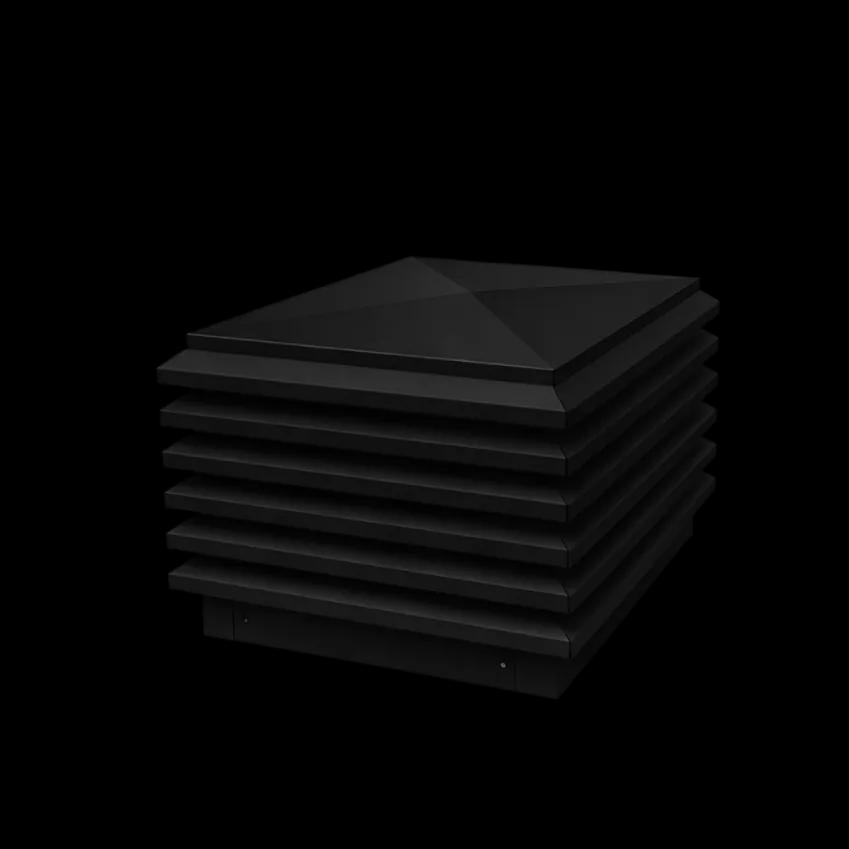
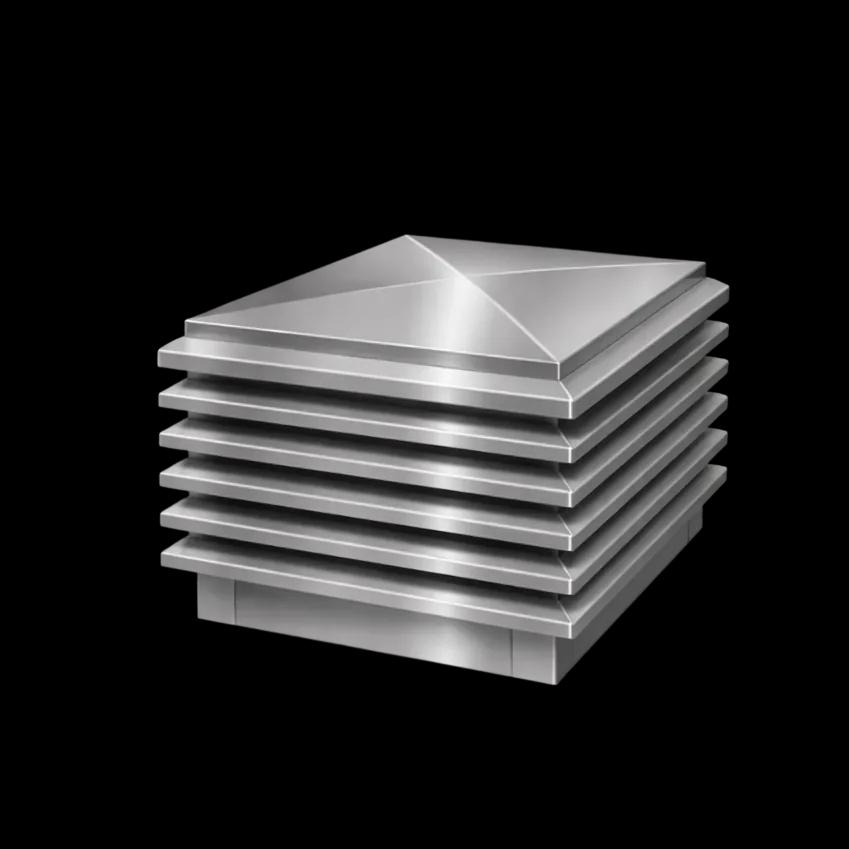
The static series is designed for kitchen extraction hoods, gas boilers and open fireplaces. Its operation depends on no motor: the louvers are designed on the Venturi principle, so that air passing between them generates suction inside the cap. That suction is what maintains natural extraction and prevents backdraft.
One manufacturing detail with practical consequences: the height of the cap and the spacing between louvers don't vary with the dimensions of the surround. In other words, a large VENTUM® maintains the same suction capacity as a small one, with no intermediate walls to reduce it.
Technical specifications
- Standard overall height: 500 mm (6 horizontal louvers plus base).
- Effective height: 405 mm.
- Height of the lower base: 95 mm, designed for rapid anchoring and to act as a drip edge.
- Thickness: 12/10 mm in lacquered aluminum; 8/10 mm in AISI 316 stainless steel.
- External dimensions: to the exact size of the masonry surround.
- Maximum temperature: 80 °C continuous.
- Joining of parts: expanding dimple points, without welding, so as not to alter the properties of the material.
- Options: removable face to ease maintenance; special heights and shapes to order.
- Reference standards: EN 13779 and Spain's CTE DB-HS 3; range adapted to Royal Decree 314/2006.
- Certification: ISO 9001:2015.
The package is rounded off by two characteristics that are appreciated on the roof: it's light and it has no sharp edges, which makes handling easier during installation.
Section 09
VENTUM® E Series: Mechanical Extraction When Natural Draft Isn't Enough
For ventilating wet rooms, bathrooms and kitchens — where regulations require a system of forced renewal of indoor air — the mechanical series incorporates one or more motors inside the cap, sized according to the volume to be extracted. The motor's power is independent of the external dimensions of the masonry surround, so a small surround doesn't limit extraction capacity.
Available motors
- HRB/4-200: 230 V, 1,475 rpm, 35 W, 0.19 A, 53 dB. Minimum surround 300 × 300 mm.
- CRHB/4-250: 230 V, 1,475 rpm, 52 W, 0.26 A, 58 dB. Minimum surround 445 × 445 mm.
- CRHB/6-315: 230 V, 980 rpm, 69 W, 0.40 A, 48 dB. Minimum surround 540 × 540 mm.
- CRHB/6-355: 230 V, 955 rpm, 87 W, 0.44 A, 58 dB. Minimum surround 610 × 610 mm.
How the motor is selected by airflow
The usual criterion is the number of Ø 100 mm ducts feeding into the cap, calculated at a duct velocity of 4 m/s. As a quick reference:
- Up to 280 m³/h (4 ducts): model HRB/4-200.
- From 350 to 700 m³/h (5 to 10 ducts): model CRHB/4-250.
- From 770 to 1,190 m³/h (11 to 17 ducts): model CRHB/6-315.
- From 1,260 to 1,680 m³/h (18 to 24 ducts): model CRHB/6-355.
One requirement not to overlook: the installation must incorporate an electronic voltage regulator to adjust the motor's power in each case and ensure the correct airflow. Without it, the motor always runs at maximum, with the consumption and noise that implies.
There is also a supply series for cases where the need is to introduce air rather than extract it.
Section 10
Materials and Finishes: When Stainless Steel Is Needed
The caps are manufactured in aluminum lacquered with polyester paint or in bright AISI 316 stainless steel. The choice isn't purely aesthetic:
- Lacquered aluminum: the standard option, with good outdoor performance and lower weight.
- AISI 316 stainless steel: recommended in locations less than 2,000 meters from the sea, where the salt load in the air is aggressive towards lacquered finishes.
The standard finishes in aluminum are black RAL 9005, anthracite grey RAL 7016, dark grey RAL 7022, natural RAL 9006 and white RAL 9003. Any other color from the RAL chart is manufactured to order at additional cost.
And for projects that don't fit the standard catalogue, we manufacture non-rectangular shapes, special sizes, connecting pieces, blind faces against walls and solutions for masonry chimneys and concrete flues.
Section 11
The Masonry Surround: The Mistakes That Doom the Draft Before Anything Is Installed
A good part of draft and noise problems is decided by how the masonry surround is built, before the cap even arrives. These are the factory's recommendations:
- Keep the ducts from each bathroom and kitchen separate all the way to the roof, to avoid noise, odours and cross-ventilation between dwellings.
- Leave the ducts 20 cm below the top level of the masonry surround once at roof level.
- Seal the ducts to one another with polyurethane foam, so that only the air inside the pipes is extracted and not that of the surround.
- Concrete the last three courses of brick solidly, preferably with reinforcement, so a strong wind pressure can't tear them off.
Installing the cap itself requires no bricklaying: the base is designed for rapid, secure anchoring onto the finished surround.
Section 12
What to Measure Before Ordering the Cap
Because every piece is manufactured to the exact size of the surround, taking the measurements is decisive. What you need to send:
External length and width of the masonry surround in millimetres, measured at the finished top.
Type of ventilation: static or mechanical extraction.
Airflow to be extracted or number of Ø 100 ducts, if the version is mechanical.
Material and color, with the corresponding RAL or the stainless steel finish.
Distance to the sea, if the project is in a coastal area.
Geometric particularities: blind faces against walls, non-rectangular shapes, special heights.
FAQ
Frequently asked questions
Does a cap always solve poor draft?+
Not always. It helps a great deal when the problem is wind, backdraft or protection of the outlet. If the cause is the height of the flue, the cross-section or a lack of make-up air, the installation has to be corrected too: the cap only acts at the outlet.
What's the difference between a static and a mechanical cap?+
The static one, C Series, uses air passing between the louvers to generate internal suction on the Venturi principle, with no motor and no electricity consumption. The mechanical one, E Series, incorporates motors inside and actively reinforces extraction when natural draft isn't enough.
Why does smoke only come back when it's windy?+
That's backdraft. Wind generates overpressure at the flue outlet and that pressure momentarily reverses the draft. It usually occurs with specific wind directions, when the outlet sits downwind of an obstacle. A cap with the correct geometry reduces it by converting that wind into suction.
Are the caps made to measure?+
Yes. Each piece is manufactured to the exact size of the masonry surround, so installation is direct and requires no adjustments on the roof and no adaptors.
What maintenance do they need?+
Very little: periodic visual inspection and cleaning of the outlet. The version with a removable face gives access to the inside without dismantling the assembly, which is especially useful on the motorised versions.
Can it be installed without building work?+
Yes. The base is designed for rapid anchoring onto the finished surround and requires no bricklaying. The surround should, however, be correctly finished and sealed before installation.
What if the flue is near the sea?+
Less than 2,000 meters from the coast, bright AISI 316 stainless steel is recommended, because the salt load in the air degrades any lacquered finish sooner.
Does the cap make noise?+
The static version doesn't, because it has no moving parts. On the mechanical version the sound pressure level depends on the motor, between 48 and 58 dB depending on the model, and the electronic voltage regulator lets you adjust the power and reduce it when maximum airflow isn't needed.
Can I fit a mechanical cap on a small surround?+
Each motor requires a minimum internal surround size, from 300 × 300 mm for the HRB/4-200 up to 610 × 610 mm for the CRHB/6-355. Below that size you have to opt for a lower-airflow motor.
Related product
VENTUM®
Made-to-Measure Chimney Caps and Cowls
Made-to-measure chimney cap, static and mechanical
Share