Key takeaways
6 min read
Key point 1
Most chimney leaks don't come from inside the flue — they come from the junction between the chimney and the roof.
Key point 2
The cap protects the mouth of the flue, but the roof's watertightness also depends on the apron flashing, the overlap, and the seal at the junction.
Key point 3
Water always finds a way: any badly resolved joint, reverse-fall, or inverted overlap ends up leaking inside.
Key point 4
Made-to-measure lacquered aluminum avoids gaps and improvised on-site adjustments, which are behind most leaks.
Key point 5
Checking the condition of the cap and the junction once a year, before the rainy season, prevents major damage to the structure.
In this article
- Where Chimney Leaks Actually Come From
- The Chimney Cap's Role: What It Protects and What It Doesn't
- The Chimney-Roof Junction: The Critical Zone
- Why Poorly Taken Measurements Cause Leaks
- Materials and Finishes That Withstand the Weather
- How to Check Your Chimney Before It Rains
- Common Mistakes That Cause Leaks
- What the Regulations Say
- VENTUM® Made-to-Measure Chimney Caps
- Frequently asked questions
A leak next to the chimney is one of the most annoying — and most misunderstood — problems on a roof. When a damp stain appears on the ceiling near the smoke outlet, the first thing many people think is that 'water is coming down the flue.' In most cases, though, the water isn't traveling down inside the chimney: it's getting in at the point where the chimney passes through the roof. In this guide we explain where leaks around a chimney really come from, what role the chimney cap plays, why the junction with the roof is the critical zone, and how to prevent leaks before they cause damage.
Section 02
Where Chimney Leaks Actually Come From
In a chimney that passes through the roof, there are two areas that can let water in, and it's worth not confusing them. The first is the mouth of the flue, right at the top: if it isn't properly protected, rain can fall straight down inside. The second — and by far the most common — is the junction between the body of the chimney and the roof: the perimeter where the chimney's masonry meets the tiles, the flashing, or the roof's waterproofing.
The vast majority of 'chimney' leaks start at that junction. It's a singular point, with changes of plane and material, exposed to water pooling behind the chimney (the face looking up the slope) and finding any weak joint. That's why preventing leaks means looking at two things: the cap crowning the flue and, above all, how the perimeter over the roof has been resolved.
Section 03
The Chimney Cap's Role: What It Protects and What It Doesn't
A chimney cap has a clear function: protecting the mouth of the flue. It limits direct rain entry, keeps out leaves and dirt, and helps stabilize draft against the wind. In that sense, a good cap does prevent part of the leaks — the ones that would get in through the mouth itself if it were left unprotected.
What a cap can't do on its own is seal the junction with the roof. That watertightness depends on other elements — the chimney's apron flashing, the overlaps, the perimeter waterproofing — which are resolved at roof level, not at the flue. Understanding this division is key: an excellent cap doesn't make up for a poorly resolved junction, and vice versa. Both need to be right for the chimney to stay leak-free.
Section 04
The Chimney-Roof Junction: The Critical Zone
The junction is the perimeter where the chimney 'emerges' from the roof. For it to be watertight, water running down the slope has to go around the chimney without getting trapped. This is achieved with perimeter flashing pieces — what's called an apron or saddle flashing on site — that catch the water on the upper (uphill) face, channel it to the sides, and return it to the roof in front, always with the overlap running the right way: the upper piece always over the one below it.
The most common mistake is reversing that overlap or leaving a reverse-fall, a small area where water pools instead of draining away. It only takes one badly resolved centimeter for water, helped by rain and wind, to find its way inside. Finishing this perimeter with made-to-measure aluminum flashing, properly overlapped and with no pooling points, is what really keeps a chimney dry.
Section 05
Why Poorly Taken Measurements Cause Leaks
Many leaks have a surprisingly simple origin: the piece didn't fit properly and got 'made to work' on site. When a cap or a perimeter flashing piece is ordered in a standard size that doesn't match the chimney's actual surround, gaps are left that have to be filled with silicone or improvised offcuts. Those fixes age badly: silicone cracks with sun and cold, offcuts leave edges water can get through, and within two or three years the leak comes back.
The way to avoid it is to take the real measurement of the finished masonry surround and order the pieces made to measure. A piece that fits straight from the factory needs no fillers or improvisation, and the junction is resolved once and for all. It's the difference between a repair that lasts and a patch you have to redo.
Section 06
Materials and Finishes That Withstand the Weather
The roof is one of the most demanding environments on a building: direct sun, rain, sharp temperature swings, and, in some areas, salinity. The material used for the cap and the perimeter flashing has to withstand all of that for years without degrading. Polyester-painted aluminum is the standard choice for its light weight, corrosion resistance, and low maintenance; in very aggressive environments, such as coastal areas, AISI 316L stainless steel adds extra resistance. A good lacquer finish — around 25 microns — holds its color and protects the metal against UV rays.
Section 07
How to Check Your Chimney Before It Rains
A simple check, done before the rainy season, prevents a lot of headaches. It's worth confirming that the cap is secure and undeformed, that the junction pieces still have their overlap and haven't shifted, that there's no cracked silicone or loose offcuts, and that water and debris aren't pooling behind the chimney. If you spot rust, open joints, or bent pieces, it's time to act: repairing while it's dry is always cheaper than doing it once there's already a leak and interior damage.
Section 08
Common Mistakes That Cause Leaks
Relying only on the cap and neglecting the junction with the roof. Reversing the overlap direction on the perimeter flashing. Leaving reverse-falls where water pools. Sealing gaps with silicone instead of using made-to-measure pieces. Reusing old, deformed caps when the roof gets replaced. And never checking the chimney until the stain appears on the ceiling. All of these are avoidable with a well-designed junction and properly sized pieces.
Section 09
What the Regulations Say
In the UK, protection against moisture at roof junctions and penetrations is a fundamental requirement of good roofing practice: flashings and abutments are detailed so they prevent water penetration at every junction and perimeter. The chimney is precisely one of those junctions that passes through the roof and must be finished with particular care. Meeting that requirement comes down to a well-designed junction, with correct overlaps and durable materials — not to any single product on its own.
Section 10
VENTUM® Made-to-Measure Chimney Caps
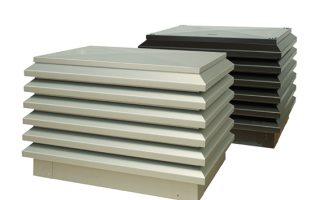
VENTUM® is Industrias Mas's range of chimney caps, made to measure in polyester-painted aluminum (3005 H44 alloy) or AISI 316L stainless steel, with anti-backflow design and ISO 9001:2015 certification. Beyond the caps themselves, at Industrias Mas we also manufacture made-to-measure special pieces — caps for masonry chimneys, blind faces against a wall, and junction solutions — so every outlet fits with no gaps. When the piece fits straight from the factory, it eliminates the improvised fillers behind most leaks.
FAQ
Frequently asked questions
Where does water get into a chimney?+
Almost always through the junction between the chimney and the roof, not through the inside of the flue. That perimeter is the critical zone where water pools and finds weak joints.
Does a good chimney cap prevent leaks?+
It prevents the ones that would get in through the mouth of the flue, but it doesn't seal the junction with the roof. To avoid leaks, both things need to be resolved properly: the cap and the perimeter over the roof.
Why does the leak come back after being repaired?+
Usually because it was sealed with silicone or offcuts instead of made-to-measure pieces. Those fixes age and fail again. A piece that fits straight from the factory lasts far longer.
How often should I check my chimney?+
Once a year, preferably before the rainy season, checking the cap, the overlaps at the junction, and making sure there's no cracked silicone or standing water.
What material holds up best on a roof?+
Polyester-painted aluminum for most cases, and AISI 316L stainless steel in coastal areas or very aggressive environments, both with a good UV-resistant finish.
Related product
VENTUM®
Made-to-Measure Chimney Caps and Cowls
Made-to-measure chimney cap, static and mechanical
Share