Key takeaways
5 min read
Key point 1
Powder-coated aluminum is the dominant material for architectural ventilation grilles: lightweight, corrosion-resistant, maintenance-free, and available in any RAL color.
Key point 2
AISI 304 or 316L stainless steel is the usual choice in industrial kitchens, food processing installations, and coastal areas with high salinity, for its resistance to chemicals and extreme humidity.
Key point 3
Galvanized steel is an economical option for indoor HVAC ducts but isn't suited to exteriors or environments with permanent humidity.
Key point 4
Plastic (PVC, ABS) is used in decorative indoor grilles but doesn't withstand UV, high temperatures, or significant mechanical stress.
Key point 5
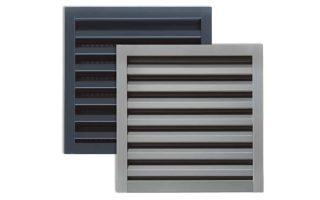
Industrias Mas manufactures powder-coated aluminum grilles with 25 microns of polyester lacquer on both sides, fixed louvers, and concealed fixing, in five standard RAL colors and any color on request.
In this article
- Powder-Coated Aluminum: The Architectural Standard
- Stainless Steel: For Particularly Aggressive Environments
- Galvanized Steel: Economical for Indoor Ducts
- Plastic (PVC, ABS): Limited to Indoor Decoration
- Direct Comparison: Aluminum vs. Stainless Steel vs. Galvanized
- Which Material to Choose Based on the Project
- Industrias Mas's Grilles
- Frequently asked questions
Ventilation grilles may look like a simple product, but the material they're made from makes the difference between a piece that lasts decades and one that rusts, warps, or loses color within a few years. The choice depends on the environment (indoor, outdoor, coastal, industrial), the type of use (residential, commercial, HVAC, industrial), and the project's aesthetic requirements. This guide reviews the four most common materials — aluminum, stainless steel, galvanized steel, and plastic — with their properties, advantages, and real on-site limitations.
Section 02
Powder-Coated Aluminum: The Architectural Standard
Aluminum is the dominant material for architectural ventilation grilles in Spain and most of Europe. Its technical properties explain why: natural corrosion resistance thanks to the surface oxide layer that forms spontaneously, light weight (2 to 3 times lighter than steel), ease of extrusion and machining into any shape, and compatibility with polyester coatings in any RAL color. Industrias Mas's powder-coated aluminum receives 25 microns of polyester lacquer applied to both sides of the profile; this treatment protects against UV, rain, and corrosion, and keeps the finish with no paint or maintenance for decades. It's the standard choice for facades, ventilated facades, SATE insulation systems, and practically any visible installation.
Section 03
Stainless Steel: For Particularly Aggressive Environments
Stainless steel is the alternative when the environment exceeds powder-coated aluminum's capacity. The most commonly used alloys are AISI 304 (industrial standard, suitable for kitchens and most installations) and AISI 316L (containing molybdenum, far more resistant to chlorides and organic acids). Its strengths are resistance to extreme temperatures with no warping, a non-porous surface that's easy to clean and disinfect, and a very long service life in aggressive environments. Its weaknesses are weight (2 to 3 times that of aluminum at the same thickness), acquisition cost, and color limitation (metallic finish, no coating). It's the usual choice in industrial kitchens, food processing plants, laboratories, and coastal front lines.
Section 04
Galvanized Steel: Economical for Indoor Ducts
Galvanized steel is carbon steel sheet coated with a zinc layer that protects it against corrosion. It's significantly cheaper than aluminum or stainless steel and is widely used in indoor HVAC ducts and hidden grilles. Its limitations are clear: the zinc layer wears down in high-humidity or chemically aggressive environments, it doesn't withstand prolonged outdoor UV exposure well, and cuts and holes made on-site leave areas vulnerable to corrosion. It's not the option for exterior facades or coastal environments.
Section 05
Plastic (PVC, ABS): Limited to Indoor Decoration
PVC and ABS grilles exist on the market, especially for decorative indoor applications and hidden ducts. They're lightweight, cheap, and easy to cut. Their limitations are significant: PVC becomes brittle with prolonged UV exposure, both materials warp at high temperatures (close to or above 60°C), they can't withstand significant mechanical stress, and they don't resist contact with solvents or certain cleaning products. For exterior facades and demanding technical applications, they're not a professional option.
Section 06
Direct Comparison: Aluminum vs. Stainless Steel vs. Galvanized
In durability for outdoor architectural use, powder-coated aluminum and stainless steel are the two valid options. In cost, powder-coated aluminum is clearly more cost-effective than stainless for most applications — and allows a RAL finish impossible to achieve with stainless steel. In weight, aluminum clearly wins: it eases installation and reduces load on the facade. In maintenance, all three require periodic cleaning, but powder-coated aluminum needs no additional treatment. In aggressive environments (chlorides, acids, industrial temperatures), AISI 316L stainless steel is irreplaceable.
Section 07
Which Material to Choose Based on the Project
For new housing, multi-family residential, and office facades, powder-coated aluminum is the standard option. For commercial buildings with modern facades requiring color coordination with window frames, powder-coated aluminum in a specific RAL is practically the only option. For industrial kitchens, food processing plants, and laboratories, stainless steel is appropriate. For coastal front-line areas with extreme salinity, AISI 316L is worth considering. For hidden indoor HVAC ducts where cost dominates, galvanized steel is defensible.
Section 08
Industrias Mas's Grilles
Industrias Mas has manufactured powder-coated aluminum ventilation grilles in Tàrrega (Lleida) since 1968. Each grille is produced to measure for the opening's dimensions, with 25 microns of polyester powder coating on both sides, fixed louvers for permanent ventilation, concealed fixing for a clean facade finish, and five standard RAL colors — black (RAL 9005), anthracite (RAL 7016), dark grey (RAL 7022), natural (RAL 9006), and white (RAL 9003) — with the option of the full RAL chart on request. Manufacturing is carried out under ISO 9001:2015 certification, backed by over 10,000 projects completed in Spain.
FAQ
Frequently asked questions
What is the best material for a ventilation grille?+
It depends on the environment and use. For exterior facades and most residential or commercial applications, powder-coated aluminum is the standard thanks to its weather resistance, light weight, and finish in any RAL color. For industrial kitchens, food processing plants, and coastal areas with high salinity, stainless steel is preferable. For indoor HVAC ducts not exposed to humidity, galvanized steel is an economical alternative.
What's the difference between anodized aluminum and powder-coated aluminum?+
Anodizing is an electrochemical treatment that controllably oxidizes the aluminum's surface to create a protective layer; the result is a metallic finish in a limited color range. Powder coating involves applying a polyester paint (typically 25 microns) that's oven-cured; it allows any RAL color and offers better UV resistance in most architectural applications. Industrias Mas uses powder-coated aluminum for its color flexibility and proven durability on facades.
Why is aluminum used instead of iron or carbon steel?+
Iron and carbon steel rust quickly on contact with atmospheric moisture, making them unsuitable for outdoor ventilation without costly, short-lived treatments. Aluminum, by contrast, forms a microscopic oxide layer that protects it naturally and, once powder-coated, keeps its finish for decades. It's also 2 to 3 times lighter than steel, which eases installation.
Do aluminum grilles hold up in coastal areas?+
Yes, provided they're powder-coated on both sides with a quality polyester finish. Untreated aluminum can suffer corrosion pitting in extreme saline environments; powder-coated aluminum with 25 microns of polyester holds up without issue in most Spanish coastal areas. For particularly aggressive environments (coastal front lines, industrial saline atmospheres), AISI 316L stainless steel is the maximum-resistance alternative.
How thick should the aluminum be on a facade grille?+
Structural thickness depends on the grille's size and the type of installation. For standard-sized facade grilles, typical aluminum sheet thicknesses run around one to two millimeters depending on the format. Industrias Mas sizes the frame and louver thickness based on size and application, ensuring rigidity without excess weight.